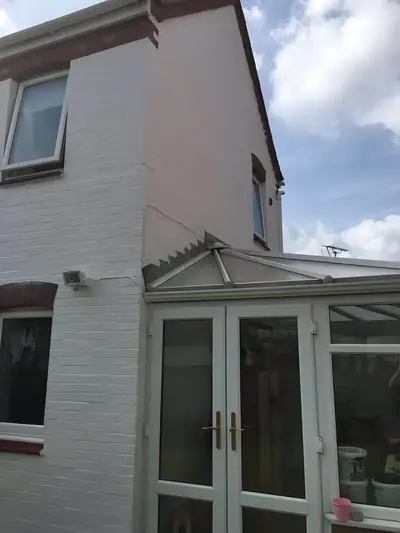
Detached and semi-detached houses have more wall to paint
At the 2021 Census, 35% of homes in Cambourne were detached and a further 28% semi-detached. More exposed sides means more scaffold or ladder work, more window frames and more fascia to cover, so Graham walks the whole outside before quoting.
Shaded sides of a house pick up green algae over time. We jet wash with an anti-fungal wash that kills the spores, let the surface dry thoroughly, then scrape and sand any flaking paint before priming bare timber.
Choosing exterior colours without a conservation area
No conservation area sits mainly within the parish, and only two buildings here are listed. That leaves most owners free to pick colours, but a front door or fascia is seen by the whole street, so we paint test patches first. If you own a shared-ownership or leasehold home, as about 8% of households here do, check the lease before changing colours.
Soffits and fascias, gutters and downpipes are best done in the same visit. Our page on painting the outside of a house covers the full checklist.
Outside walls and woodwork across a young town
Of the 4,359 Cambourne homes the 2021 Census sorted by type, 2,734 were detached or semi-detached, 62.7% of the total. Each of those has at least one exposed side wall as well as a front and a back, and a detached house has four elevations, so there is more masonry to wash and more fascia, soffit and window joinery to prepare than on a mid-terrace. On a house like that we list the soffits and fascias, the walls and the joinery as separate items in the written quotation.
Checkatrade reviews from the CB23 postcode district, which reaches beyond Cambourne to villages such as Hardwick and Papworth Everard, give a fair idea of the exterior work asked for nearby: fascias, soffits and masonry painted along with the window and door woodwork, and a rendered bungalow whose wall cracks were repaired before it was painted. They come from the district as a whole, so they show jobs near the town rather than necessarily in it.
Figures from 2021 Census (ONS); Valuation Office Agency Council Tax stock by build period; Met Office 1991-2020 climate averages; Historic England's National Heritage List; Historic England conservation areas. Source: Office for National Statistics licensed under the Open Government Licence v.3.0. Contains public sector information licensed under the Open Government Licence v3.0. © Crown Copyright 2026. Contains Ordnance Survey data © Crown copyright and database right 2026. Released under OGL. © Historic England and Local Planning Authorities 2026.
Cambourne at a glance
- 11 milesfrom our Landbeach base in a straight line, about 16 minutes by roadOSRM routing
- 90%are houses rather than flatsCensus 2021
- 35%of homes are detachedCensus 2021
- 3%of properties were built before 1919VOA Council Tax stock
- 2%were built 1945 to 1964VOA Council Tax stock
Sources: Census 2021 for Cambourne parish (ONS); Council Tax: stock of properties, 2026; road distance by OSRM.
Listed buildings in Cambourne
- Great Common FarmhouseGrade II listed
- Mile Post Near Junction with Elsworth RoadGrade II listed
Sources: Historic England listed buildings.
Planning: check before you change colours
Cambourne has no conservation area, and the town isn't named on the council's Article 4 list (checked October 2026), although that list doesn't say it is complete. Great Common Farmhouse is Grade II listed, and South Cambridgeshire District Council says listed building consent is required for any work that affects the character of the building. If your home is listed, or you aren't sure whether a restriction applies, check with the council before changing an outside colour.
Search for local planning restrictions (Greater Cambridge Shared Planning) · Listed buildings (Greater Cambridge Shared Planning)
How we approach exterior painting
On a detached or semi-detached Cambourne house we take one elevation at a time: an anti-fungal jet wash, time for the wall to dry thoroughly, then scraping, filling cracks in brick or render with an exterior filler and priming any bare timber. The fascias, soffits and gutters on each side are finished before the wall below them, so nothing drips onto fresh masonry paint. A test patch of any new colour goes on a discreet wall first, and garages or garden walls are quoted as their own items.
Best time of year for the work
At the Met Office's Cambridge NIAB station, about 8 miles east of Cambourne, the 1991-2020 averages make March and February the driest months, at 33 mm and 36 mm of rain, but they also average 5.2 days and 8.7 days of air frost. May and September have the fewest rain days, 7.3 days and 8 days with 1 mm or more, and June to September average no air frost at all, which is why we aim outside repaints at late spring to early autumn.