
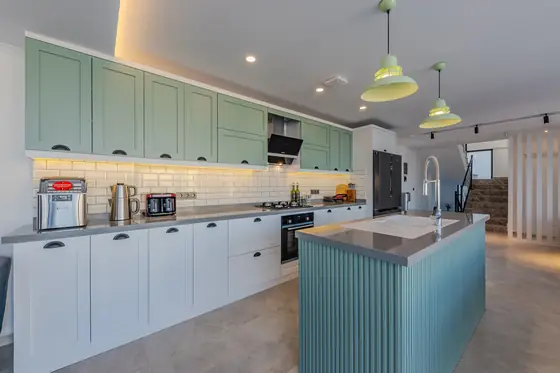
Kitchens from the 1980s onwards
Around 220 Hardwick homes date from 1983 to 1992, and roughly 90 more from 2000 to 2008, according to Council Tax records. Kitchens of that age often have solid carcasses with years left in them, while the door finish has dulled or yellowed around the handles.
Graham checks the doors at the visit. Painted timber, solid wood and MDF all take paint well when prepared properly, and if a door finish is unlikely to hold a coating, he'll tell you then rather than after we've started.
Spraying or brushing a family kitchen
Our Graco Ultra cordless airless handheld sprayer gives the flattest finish on slab doors and long runs, which helps on the bigger kitchens that many four-bedroom houses have. Just over a third of Hardwick homes have four or more bedrooms.
Shaker doors can look better brushed, and a small kitchen often takes longer to mask than to paint. We'll recommend whichever suits your room. Timber worktops can be oiled at the end, as covered on our staining and varnishing page.
Hardwick at a glance
- 11 milesby road from our Landbeach base, about 15 minutesOSRM routing
- 77%of homes are owner-occupiedCensus 2021
- 34%of households own with a mortgageCensus 2021
- 19%were built 1983 to 1999VOA Council Tax stock
- 28%were built since 2000VOA Council Tax stock
- 97%are houses rather than flatsCensus 2021
How we approach kitchen cabinet painting
Doors and drawer fronts are labelled and taken off, or masked in place. Each door and panel is then degreased, keyed with Mirka dust-free sanders and primed in a Zinsser product matched to whatever finish was there before. We then apply an eggshell or satin woodwork paint from Tikkurila, Farrow & Ball or Dulux, and wooden worktops can be finished with Osmo oil. The full method, products and FAQs are on our kitchen cabinet painting page.