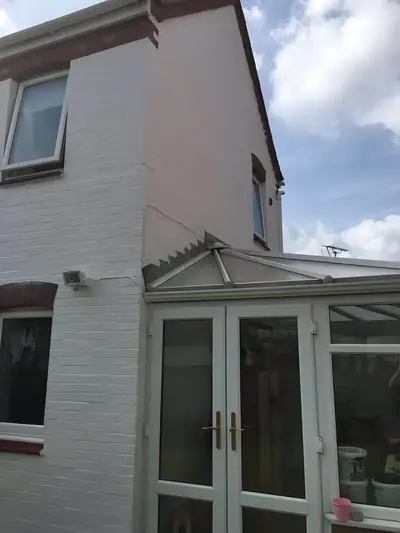
Exterior house painting in Chatteris
There were 1,764 detached and 1,651 semi-detached homes at the Census. Graham walks round every elevation before quoting, looking for cracked masonry, blown render, failed putty and rotten timber, and those repairs are listed separately in the quotation. Bigger repairs go to our master builder or carpenter.
Shaded walls collect algae and mould. We jet wash them with an anti-fungal wash, let them dry, then scrape back and repaint, as on the house in our exterior restoration case study.
Painting inside the Chatteris conservation area
The town has a designated conservation area, and listed buildings include terraces at 35 to 39 and 38 to 48 New Road.
Older brick needs a breathable masonry paint so moisture can escape. We paint test patches somewhere discreet so you can see a colour in daylight. Our main house painting page explains the survey stage.
Exposed walls, wet weather and the Chatteris conservation area
Detached houses make up 36.7% of Chatteris homes, more than one in three, and each has four elevations to prepare, plus the fascias and soffits along the roofline. On an exposed side the paint tends to break down first, so the amount of scraping, filling and repair can differ a lot from one wall to the next.
Damp is one of the main things that spoils exterior paint, and the nearest long-term averages show how often it rains. At the Met Office's Mepal station, about 3 miles south-east of Chatteris, the 1991-2020 figures record 1 mm of rain or more on about 108 days a year. A shaded wall that stays damp between showers grows algae and mould, so it's jet washed with an anti-fungal wash and left to dry out fully before any repairs or paint.
Chatteris also has a conservation area, which the council's record on planning.data.gov.uk dates to April 1975, and the town's list entries include 3 Market Hill, one of 8 on Market Hill alone. Graham asks about both at the visit, so any conversation with the council happens before colours are chosen and access is booked.
Figures from 2021 Census (ONS); Met Office 1991-2020 climate averages; Historic England's National Heritage List; Historic England conservation areas. Source: Office for National Statistics licensed under the Open Government Licence v.3.0. Contains public sector information licensed under the Open Government Licence v3.0. © Crown Copyright 2026. Contains Ordnance Survey data © Crown copyright and database right 2026. Released under OGL. © Historic England and Local Planning Authorities 2026.
Chatteris at a glance
- 14 milesfrom our Landbeach base in a straight line, about 29 minutes by roadOSRM routing
- 92%are houses rather than flatsCensus 2021
- 37%of homes are detachedCensus 2021
- 14%of properties were built before 1919VOA Council Tax stock
- 1conservation areaHistoric England
- 10%were built 1945 to 1964VOA Council Tax stock
Sources: Census 2021 for Chatteris parish (ONS); Council Tax: stock of properties, 2026; Historic England conservation areas; road distance by OSRM.
Listed buildings and conservation areas in Chatteris
- Church of Saint Peter and Saint PaulGrade I listed
- 38-48, New RoadGrade II listed
- 35, 37 and 39, New RoadGrade II listed
- ChatterisConservation area
Sources: Historic England listed buildings; Historic England conservation areas.
Planning: check before you change colours
If your house is listed or inside the Chatteris conservation area, ask Fenland District Council before changing the colour of walls, woodwork or the front door, and before painting brick that has never been painted. Historic England's list shows whether an address is listed, and the council's own record of the conservation area is on planning.data.gov.uk.
Chatteris conservation area: the council's record on planning.data.gov.uk · Historic England list entry for 3 Market Hill
How we approach exterior painting
On a detached Chatteris house Graham surveys each elevation in turn and lists the repairs he finds in the written quotation. Walls are jet washed with an anti-fungal wash and left to dry, then scraped and sanded back to sound paint, with powdery areas stabilised and cracks filled with an exterior filler. Bare timber is primed and undercoated, masonry gets a breathable paint, and gutters and downpipes are painted while the access is up for the fascias. If the survey turns up structural problems, our master builder or carpenter deals with them before any painting.
Best time of year for the work
Exterior paint needs dry walls and no frost. At the Met Office's Mepal station, air frost averaged about 42 days a year between November and March over 1991-2020, against under one day in total from May to September, so May to September is when we aim to book outside painting. We still watch the forecast and stop rather than paint a wet wall.