
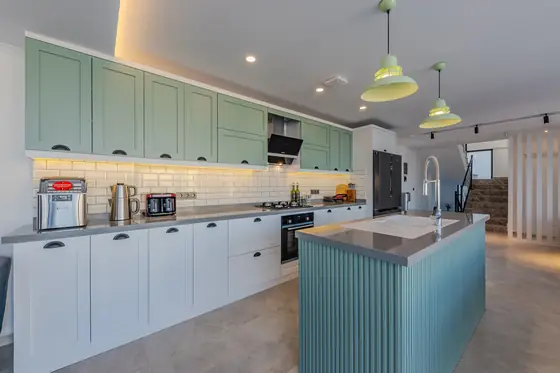
Kitchens from the 1980s, 1990s and 2000s
Council Tax records put around 1,160 homes in the 1983 to 1999 bands and another 900 between 2000 and 2008. Plenty of kitchens from those decades still have years of use left in the carcasses. If the layout works, painting the doors keeps the worktops, sink and appliances where they are.
At the visit, Graham looks closely at what your Royston doors are made of. Painted timber, solid wood and MDF take paint well with the right preparation. Glossy foil-wrapped doors are harder, and he'll be honest if yours aren't suited.
A finish that stands up to daily use
Kitchen doors are handled more than any other painted surface in the house. We degrease thoroughly, paying most attention to doors near the hob and the bin, sand with Mirka dust-free sanders and prime with Zinsser before the top coats. Eggshell has a softer look; satin is easier to wipe.
Dark base units against pale walls are a popular combination. At a converted telephone exchange in Fulbourn the trim went in Dulux Night Jewels, and the timber worktops were oiled with Osmo.
Royston at a glance
- 22 milesby road from our Landbeach base, about 32 minutesOSRM routing
- 71%of homes are owner-occupiedCensus 2021
- 34%of households own with a mortgageCensus 2021
- 14%were built 1983 to 1999VOA Council Tax stock
- 28%were built since 2000VOA Council Tax stock
- 80%are houses rather than flatsCensus 2021
How we approach kitchen cabinet painting
We'd label and remove doors and drawer fronts, mask worktops, tiles and appliances, and degrease everything. After sanding and filling chips, a primer suited to the surface goes on. Flat doors may be sprayed with our Graco Ultra handheld for a brush-free finish; Shaker doors are often better brushed. Two top coats complete the job. The full method, products and FAQs are on our kitchen cabinet painting page.