Skimming over textured ceilings
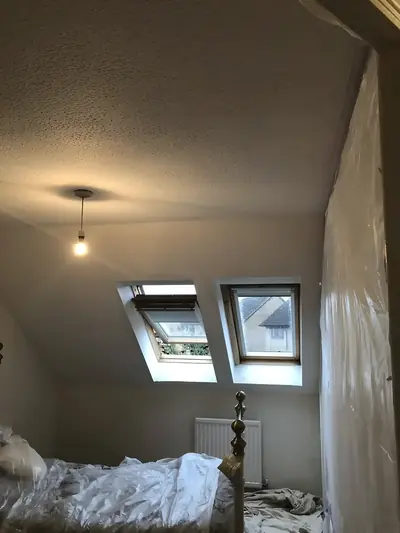
Lewis, our plasterer, and a master plasterer we work with skim textured ceilings smooth so they're ready for paint. It's usually quicker and less disruptive than taking a ceiling down. The room is cleared or covered first, and light fittings and smoke alarms have to come down beforehand.
One Cambridge customer said how clean and tidy Lewis left the house afterwards; the skimming case study has photos.
Plastering older walls and newer cracks
About 560 Littleport homes predate 1919, and their walls may be lath and plaster or older lime. Stripping paper sometimes shows how fragile they are. Graham decides at the survey whether a wall needs a skim or careful filling and lining.
Newer houses have their own problem: settlement cracks in plasterboard ceilings. Hairlines can be filled by a decorator; deeper or recurring cracks may point to a leak or movement, and we'll tell you if we think so.
Textured-ceiling years and pre-1900 walls in Littleport homes
Textured ceilings such as Artex were widely used in the post-war years, and Littleport has a fair number of homes from the later part of that period: Council Tax records date 200 properties to 1955-64, 260 to 1965-72 and 380 to 1973-82. A house of that age may still have its original textured ceiling, or one added later, and Lewis, our plasterer, can skim it smooth so it's ready for paint. Before anyone drills, sands or scrapes a textured coating, read our note on Artex and asbestos.
At the other end of the age range, Council Tax records date 9.0% of Littleport's properties to before 1900, and walls of that age are often soft, uneven and patched. Not every one of them needs a skim: sometimes careful filling and lining paper is the better answer, and Graham says which at the visit, so you aren't paying for more plastering than the room needs.
Figures from Valuation Office Agency Council Tax stock by build period; Historic England's National Heritage List. Contains public sector information licensed under the Open Government Licence v3.0. © Crown Copyright 2026. Contains Ordnance Survey data © Crown copyright and database right 2026. Released under OGL.
Littleport at a glance
- 14 milesfrom our Landbeach base in a straight line, about 23 minutes by roadOSRM routing
- 12%were built 1945 to 1964VOA Council Tax stock
- 13%were built 1965 to 1982VOA Council Tax stock
- 12%of properties were built before 1919VOA Council Tax stock
- 4,107householdsCensus 2021
- 8%date from 1919 to 1939VOA Council Tax stock
Sources: Census 2021 for Littleport parish (ONS); Council Tax: stock of properties, 2026; road distance by OSRM.
Listed buildings: check before plastering
If your Littleport house is listed, talk to East Cambridgeshire District Council before old plaster is stripped out or replaced. Its listed buildings page says: “Normally repairs and maintenance will not require consent when they are carried out on an exact like-for-like basis, using traditional materials.” Whether a particular plaster repair meets that test is for the council to decide.
How we approach plastering
In a Littleport house from the 1950s to the 1980s, the first question is whether a textured ceiling has been tested, if there's any doubt about what's in it. Then the room is cleared or sheeted, light fittings and smoke alarms come down, and Lewis prepares the surface so the new plaster bonds before he skims. Once the skim has dried right through, we seal it with a thinned mist coat, fill anything that shows and apply two full coats; coving goes up before the last of them. For the full method and the products we use, see our plastering page.