
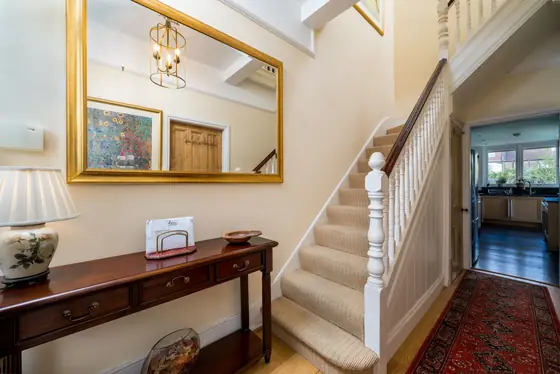
Staining staircases and internal doors
A stained staircase is the first thing you see in many hallways. We sand treads, handrails and spindles before staining so the colour takes evenly, then add a clear protective coat where it wears. In Fordham, Valter and Denes stained a staircase and doors that Mrs M Turner called an amazing transformation.
On a panelled door the stain goes onto the recessed panels before the frame around them, which stops darker bands forming where wet edges meet. Handles and hinges are masked or removed.
Older joinery and listed buildings
Roughly 930 Littleport properties were built before 1940, and those homes tend to have deeper skirtings, picture rails and panelled doors carrying many layers of old paint. We fill dents, sand back drips and seal open joints before the new finish. For any of the town's 9 listed buildings, check what the listing covers before altering original timber.
Bare pine is primed with Zinsser so knots don't bleed through, and exposed beams can be oiled with Osmo. Walls and ceilings in the same rooms are covered by our interior decorating service.
Littleport at a glance
- 16 milesby road from our Landbeach base, about 23 minutesOSRM routing
- 12%of properties were built before 1919VOA Council Tax stock
- 8%date from 1919 to 1939VOA Council Tax stock
- 89%are houses rather than flatsCensus 2021
- 9listed buildingsHistoric England
- 62%of homes are owner-occupiedCensus 2021
How we approach woodwork staining & varnishing
We test stain on a hidden area first so you can approve the shade. Old varnish is sanded off evenly, because leftover patches take colour differently. Woodwork is cleaned, keyed and lightly sanded between coats with Mirka dust-free sanders. Painted trim can be gloss, satin or eggshell, and needn't be white. The full method, products and FAQs are on our woodwork staining & varnishing page.