
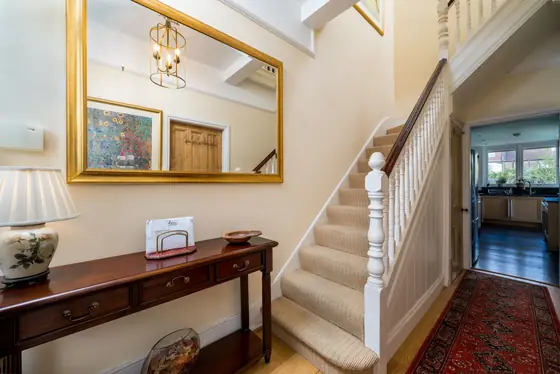
Woodwork staining and varnishing in Cottenham's older houses
In the village's pre-1919 homes, staircases, panelled doors and deep skirtings have usually been painted many times. We sand through enough to get a sound surface without losing the moulding detail, fill knocks and splits, and use Zinsser primer on bare pine to lock in the knots.
Cottenham has 65 Grade II listed buildings, and in those original joinery deserves particular care, so we repair and refinish it rather than replace it wherever we can.
Stain, varnish or paint
If you'd like to see the grain, stain and a clear varnish are an option where the timber is good enough, and a trial patch somewhere out of sight comes first. Where it isn't, Tikkurila satin or a good eggshell gives a smooth, hard-wearing finish with less shine than gloss.
Our skirting board and woodwork painting and staircase painting pages go into more detail, and one of our videos shows Josh and Toby prepping stairs before waxing.
Cottenham at a glance
- 3 milesby road from our Landbeach base, about 6 minutesOSRM routing
- 15%of properties were built before 1919VOA Council Tax stock
- 6%date from 1919 to 1939VOA Council Tax stock
- 94%are houses rather than flatsCensus 2021
- 66listed buildingsHistoric England
- 73%of homes are owner-occupiedCensus 2021
How we approach woodwork staining & varnishing
We protect floors, clean grease from handles and push plates, and sand with Mirka dust-free sanders so the house stays clean. Gaps between skirting and wall are filled with flexible filler. Stain is tested, then applied with the grain and sealed with clear coats; paint goes over primer, with a fine sand between coats for a smooth finish. The full method, products and FAQs are on our woodwork staining & varnishing page.