William Morris wallpaper works beautifully on stairs and landings, but a stairwell is the hardest place in a house to hang it. The drops are long, the walls slope with the stairs, and the Morris & Co. papers we checked have vertical pattern repeats of 46 to 64cm. You need more rolls, careful setting out and safe access over the stairs.
This draws on a job we documented in central Cambridge, where our wallpaper specialist hung a William Morris paper through the hall, stairs and landing on three levels.
Why William Morris wallpaper on stairs is harder than in a room
In a bedroom every drop is roughly the same length and you can reach the top from a stepladder. On a staircase, almost nothing is standard.
- Long drops. The wall beside the flight can be far taller than a room, especially where it rises past a half landing.
- Raking walls. The bottom edge follows the line of the stairs, so each drop is a different length and has to be measured and cut on its own.
- One continuous pattern. The paper usually runs from the hall, up the flight and round onto the landing. A pattern that drifts out of level at the bottom gets more obvious with every metre of height.
- Access. The Health and Safety Executive describes ladders as "a sensible and practical option for low-risk, short-duration tasks". Papering a long stairwell is rarely a short task, so decorators generally set up a platform over the stairs instead of balancing a ladder on the treads.
Hallway wallpaper also takes knocks from bags, coats and bikes, so it is worth hanging it on walls that are properly prepared rather than rushing to the pattern.
| Willow Boughs (217083) | 46 cm |
|---|---|
| Strawberry Thief (MOW0171-02) | 61 cm |
| Pure Pimpernel (216539) | 64 cm |
Morris & Co. pattern repeats and roll sizes
The pattern repeat is the distance before the design starts again down the roll. The bigger it is, the more paper you waste matching each drop to the last. These are the figures Morris & Co. publishes for three of its best-known designs (checked 23 October 2026):
| Design (product ref) | First designed | Roll width | Vertical repeat | Match |
|---|---|---|---|---|
| Strawberry Thief (MOW0171-02) | 1883 | 52cm | 61cm | Straight |
| Pure Pimpernel (216539) | 1876 | 68.6cm | 64cm | Straight |
| Willow Boughs (217083) | 1887 | 52cm | 46cm | Straight |
All three rolls are 10.05 metres long. Morris & Co. says nearly all wallpapers sold by the roll are that length and that the standard width is 52cm, but this can vary, as the wide-width Pure Pimpernel shows. Repeats also differ between versions of the same design, so always check the product code you are ordering rather than the pattern name.
Large repeats are part of the Morris tradition. The V&A notes that Morris produced over 50 wallpapers, that nearly all his early papers were printed from hand-cut woodblocks, and that his St James's design needed 68 separate printing blocks for a repeat spread across two widths of paper, with a vertical repeat of 127cm. Today's Morris & Co. papers are made in the company's UK factory from the original 19th-century designs in its archive.
How many rolls of William Morris wallpaper does a staircase need?
Morris & Co.'s online calculator allows for the pattern repeat and adds 10cm per drop for trimming top and bottom. It also states plainly that it makes no allowance for uneven or sloping walls. A stairwell is exactly that kind of wall, so treat the calculator's answer as a starting point.
A simplified example shows why staircases use more paper, using the published Strawberry Thief figures (our own arithmetic, not a manufacturer calculation):
- A normal room. A 2.4m wall plus 10cm trim needs 2.5m of paper per drop. With a 61cm repeat, each drop uses five full repeats, about 3.05m, so one 10.05m roll gives three drops.
- A tall stair wall. A 4.5m drop plus trim needs 4.6m. Rounded up to whole repeats that is eight, about 4.88m, so the same roll gives only two drops.
That is a third fewer drops per roll on the tall wall. On a smaller repeat such as Willow Boughs at 46cm the waste is lower, which is one reason to compare repeats before you fall for a design.
Practical points when ordering:
- Measure each wall at its tallest point, including the stretch beside the flight.
- Decorators generally order an extra roll or so on expensive papers, because a second order may come from a different print batch and the shade can differ slightly.
- Order samples first. Morris & Co. says samples are the best way to see the true colour, texture and finish in your own light, and a hall with one small window can make a design look very different from the website.
Preparing the walls before the first drop
On our central Cambridge staircase job, the order of work was set by the house. Our master plasterer dealt with the ceilings first, while the team stripped the old wallpaper from the hall, stairs and landing across all three levels. Only then did the new paper go up. Photos from the job show the stairwell and landing with patchy, stripped walls before papering began.
That order matches the manufacturer's own advice. Morris & Co.'s hanging guide says the old paper should be stripped, the walls should be smooth to the touch, holes filled, and lining paper considered where surfaces are still uneven. It also suggests painting first and papering last, so there is no risk of splashes on new paper.
On a stairwell that usually means:
- repairing or replastering ceilings and cracked areas (our plastering team works alongside the decorators, so the plastering and decorating go in one written quotation)
- stripping and washing down old paper, then making good
- lining the walls where the plaster is poor
- painting ceilings, banisters, spindles and skirtings before any wallpaper goes on
If stripping reveals tired plaster, it is better to deal with it then. A heavy, expensive paper will not hide a poor wall for long.
Hanging the paper through the hall, stairs and landing
Morris & Co.'s guide covers the basics that apply anywhere: check the pattern is the right way up, leave about 5cm extra at the bottom of each drop, paste the wall or the paper according to the instructions for that product, smooth out air with a clean dry brush, and wipe off paste with a damp cloth.
On a staircase, a few things matter more:
- Plumb every drop. On our wallpapering jobs, including designer and William Morris papers, each length is checked with a plumb line rather than lined up against the previous one, because a small error repeated up three floors becomes a large one.
- Plan where the pattern sits. Decide where a strong motif will fall along the ceiling line on the landing, where it is seen most, and work out from there.
- Handle long drops carefully. Long lengths are pasted and folded so they can be carried up and hung without creasing.
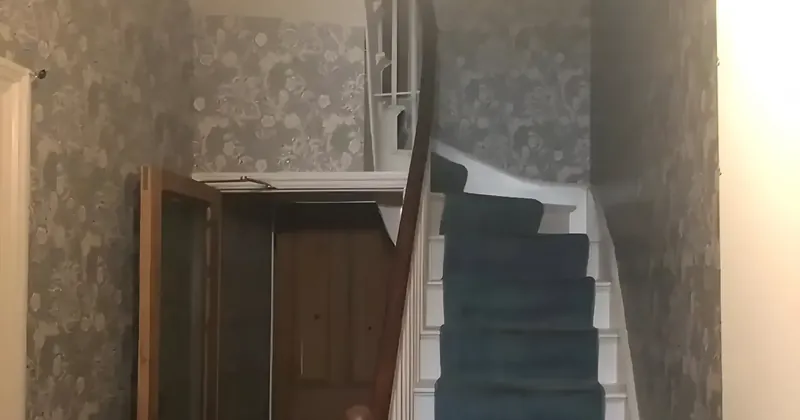
- Cut neatly round obstacles. Stairwells collect pipes, alarm points and odd windows. On the Cambridge job the paper was cut around white pipework and a fire extinguisher, hung beside a round window and stair handrail, and taken round curved walls at a turn in the hall.
You can see those details in the case study photos, including the finished staircase with the paper running up both walls.
Protecting existing paper while other work goes on
Sometimes part of the house already has a William Morris paper worth keeping. On the same Cambridge project, one room had an existing William Morris wallpaper, which we protected while the ceiling above was plastered. Another room was prepared and painted in Dulux rather than papered.
If you are planning a staircase, it is worth saying at the start which papers stay, so the plastering and stripping can be organised around them.
When to hang it yourself and when to call a decorator
Hanging a straight-match paper on a single hall wall at normal room height is a reasonable DIY job if you are patient and have hung paper before.
A full stairwell is different. Bring in a decorator if:
- the drops run past a half landing or over more than one floor
- you would need to work above the stairs from anything other than a proper platform
- the paper is expensive and a miscut drop is costly to replace
- the walls need stripping, plaster repairs or lining first
One Checkatrade customer described our wallpaper specialist's work like this:
Wallpaper hanging by Simon was perfect can't see joins and perfectly aligned.
Planning a William Morris staircase in Cambridge
Graham will visit, look at the walls and the paper you have in mind, and tell you honestly what preparation is needed and how many rolls to allow for the repeat. You then get a written quotation that sets out the preparation and hanging. Have a look at our wallpaper hanging service, browse the project gallery, or ask for a free quote.
Questions people also ask
How many rolls of William Morris wallpaper do I need for stairs?
It depends on the tallest drops and the pattern repeat. Morris & Co.'s calculator allows for the repeat and 10cm trim per drop but not for sloping walls, so measure each wall at its tallest point and expect fewer drops per roll than in a normal room.
Is William Morris wallpaper paste the wall or paste the paper?
It varies by product. Morris & Co.'s hanging guide says to paste either the wall or the paper according to the method listed on the packaging, so check the roll or product page before you start.
Do I need lining paper before hanging William Morris wallpaper?
Not always. Morris & Co. suggests considering lining paper where walls are still uneven after filling. Older plaster on stairwells often benefits from it, and Graham will say at the visit whether your walls need it.
Can you keep an existing William Morris paper while other rooms are done?
Yes. On our three-storey Cambridge job we protected an existing William Morris paper in one room while the ceiling above it was plastered.
Talk to Graham about your wallpapering
Graham visits free of charge, looks at the job with you and sends a detailed written quotation. You don't pay until you're happy with the finished work. We only take on work within 15 miles of Landbeach, which takes in Cambridge and the towns and villages around it: find your area.
Sources
- Strawberry Thief Wallpaper, Product Ref MOW0171-02, Morris & Co. (checked 23 October 2026)
- Pure Pimpernel Wallpaper, Product Ref 216539, Morris & Co. (checked 23 October 2026)
- Willow Boughs Wallpaper, Product Ref 217083, Morris & Co. (checked 23 October 2026)
- Wallpaper quantity calculator, Morris & Co. (checked 23 October 2026)
- How to hang wallpaper with Morris & Co., Morris & Co. (checked 23 October 2026)
- Wallpaper, Morris & Co. (checked 23 October 2026)
- William Morris and wallpaper design, V&A (checked 23 October 2026)
- Safe use of ladders and stepladders, Health and Safety Executive (checked 23 October 2026)
Written by Graham Halpenny Decorators. Third-party prices, product data and regulations are credited to their source with the date we checked them; they are not our prices. Spotted something out of date? Let us know.