The best paint for kitchen cabinets is a hard-wearing, water-based trim or furniture paint in eggshell or satin, applied over a primer that suits what the doors are made of. Tikkurila Helmi, Farrow & Ball Modern Eggshell and Dulux Quick Dry Satinwood are all made for interior woodwork. But no tin will stay on greasy, shiny doors that haven't been cleaned, keyed and primed. Preparation decides how long the finish lasts.
This guide compares what the manufacturers publish, explains which primer to use on wood, painted, MDF and melamine doors, and sets out the preparation that stops paint chipping around the handles.
Is there one best paint for kitchen cabinets?
Not one that the evidence supports. The top search result for this question is an American test of American paints, and we found no independent UK test comparing cupboard paints side by side. What manufacturers do publish is enough to choose well, if you look for three things:
- A paint made for woodwork or furniture, not walls. Wall emulsion isn't designed to be handled every day.
- Published durability data, such as a wet scrub or wet abrasion class, so you know it will take wiping.
- A matching primer system for your door material, because the paint is only as good as what it sticks to.
How three kitchen cabinet paints compare
These figures come from each maker's own product page or data sheet, checked on 23 October 2026. They are not our test results.
| Tikkurila Helmi 30 | Farrow & Ball Modern Eggshell | Dulux Quick Dry Satinwood | |
|---|---|---|---|
| Finish | Semi-matt, 30% (also made as Helmi 10 matt and Helmi 80 gloss) | Eggshell, 40% sheen | Satin, mid-sheen |
| What the maker says it is for | Interior trim and furniture, including kitchens and cabinets | "Kitchen cabinetry, skirting boards, stairs, floors" | Interior wood and metal |
| Durability claim | Wet scrub class 1 | Wet abrasion class 1; "the toughest product in our range" | Wipeable, non-yellowing |
| Coverage | 8 to 10 m² per litre | Up to 12 m² per litre | Up to 16 m² per litre |
| Drying and recoat | Dust-dry after 1 hour; recoat after 16 hours (data sheet) | Dry in 2 hours; recoat after 4 hours | At least 6 hours between coats |
| Full hardness | Usable hardness after 2 to 3 days; final hardness after about a month | Up to 14 days for some darker colours | Not stated on the product page |
Tikkurila's product page gives a recoat time of 2 to 4 hours, but its Helmi 30 technical data sheet (dated 6 November 2024) says 16 hours, so follow the data sheet. And Dulux describes Quick Dry Satinwood as self-undercoating, which is convenient on previously painted wood but doesn't replace an adhesion primer on shiny surfaces.
We use Tikkurila, Farrow & Ball and Dulux on woodwork, and on one whole-house project finished the woodwork in Tikkurila white satinwood. Eggshell gives a softer, flatter look that suits period kitchens. Satin is a little shinier and a little more forgiving to wipe.
The best primer for painting kitchen cabinets depends on the doors
Work out what your doors are made of first.
Solid wood and bare MDF
Bare timber and MDF need a proper wood primer. Farrow & Ball specifies its Wood Primer & Undercoat under Modern Eggshell. Tikkurila recommends Helmi Primer for solid wood in its guide to painting kitchen cabinets.
On MDF, Farrow & Ball advises lightly sanding the edges to reduce how much paint they absorb, and sanding between coats if the fibres rise. Knots in pine bleed through pale paint. Farrow & Ball suggests a knotting solution or aluminium-based primer for severe knots, and Tikkurila recommends its Multistop Primer for knotty and yellowed wood. Zinsser lists knots and sap streaks among the stains its B-I-N Aqua primer seals.
Doors that have been painted before
If the existing paint is sound, you may not need a full primer coat. Tikkurila's guide says previously painted cabinets may need only "a very good sanding", especially if the new colour is close to the old one. If the old paint is worn, it recommends its Otex Akva adhesion primer. Its data sheet says to wash previously painted surfaces, scrape off any loose paint, and sand hard, glossy and factory-painted surfaces until they are no longer glossy.
Melamine, laminate and other shiny surfaces
Melamine and laminate doors can be painted, but they need an adhesion primer. Farrow & Ball's advice for "difficult surfaces" such as melamine, PVC and laminates is to degrease, lightly abrade for a physical key, clean thoroughly, and then apply "a specialist adhesion primer". Two examples:
- Tikkurila says its Otex Akva primer adheres to surfaces including melamine, PVC, tiles and glass, and is touch dry after about an hour.
- Zinsser describes Bulls Eye 1-2-3 as a water-based stain-blocking sealer and adhesion primer that dries to recoat in 1 hour.
The makers don't agree on sanding. Zinsser says Bulls Eye 1-2-3 "adheres to most surfaces without pre-sanding or deglossing", and Tikkurila's how-to page says sanding can be skipped on melamine. Farrow & Ball's advice and Tikkurila's own data sheet both say to key glossy surfaces. We take the cautious route and always lightly sand, because a light key costs little and the primer can only grip what it touches.
We've painted melamine kitchens before. A Checkatrade customer in CB4, whose job was "decorating kitchen throughout including painting melamine cabinets", wrote:
Jack did a most impressive and efficient job. He planned his work well, provided me with useful information on how he intended to tackle the challenges involved and produced an excellent finish throughout. He was very considerate and left the whole area very clean and tidy after each session.
Vinyl-wrapped and waxed doors
Some doors are covered in a thin plastic foil. If that foil is lifting at the edges, decorators generally won't paint it, because the paint can't hold down a wrap that is already coming away. Waxed or polished wood is another trap. Farrow & Ball says existing wax or polish has to be sanded off first, and to test a small area because its paints may not be compatible with some waxes.
How to prepare kitchen cabinets for painting
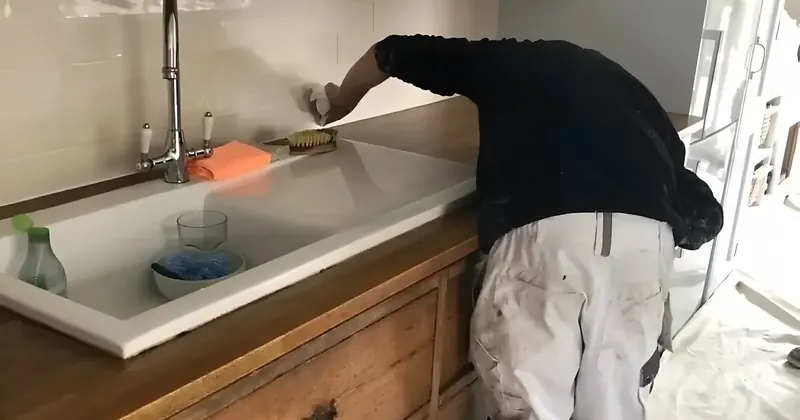
Kitchen doors collect a film of grease, especially near the cooker and around the handles, and paint will not bond to it. The manufacturers' guidance and our own kitchen cabinet painting process follow the same order:
- Take off doors, drawer fronts, handles and hinges, and label each door so it goes back in its place.
- Degrease everything. Tikkurila recommends an alkaline cleaner that removes dirt, grease, oil and wax, rinsed off with water afterwards. Farrow & Ball suggests a dilute sugar soap solution and warns against solvent-based or strongly alkaline cleaners, which can affect adhesion. Use whichever the maker of your paint recommends.
- Sand to a dull, even key, and dust off. We use Mirka dust-free sanders, which extract the dust as they work.
- Fill chips and dents, then sand flush.
- Prime with the right product for the surface.
- Apply two coats, sanding lightly between them. Tikkurila's guide says to sand with fine paper once the first coat is completely dry. Farrow & Ball advises laying off the final strokes along the grain, finishing at the joints.
Brush, roller or spray?
All three can give a good finish. Farrow & Ball recommends a fine-tipped synthetic brush where the best finish is needed, and says a medium-pile woven polyester roller gives minimal stippling. Both Farrow & Ball and Tikkurila publish airless spray settings, and both say only limited thinning should be needed, so check the data sheet before you thin anything.
Spraying gives the most even, brush-free finish on flat doors, but every worktop, floor and appliance has to be masked first. We own a Graco Ultra cordless airless handheld sprayer and use it where a factory-like finish is worth the masking time. In a small kitchen, a brush and roller is often quicker overall.
How long until you can use the cupboards normally?
Dry is not the same as cured. Farrow & Ball says to allow at least 14 days before cleaning Modern Eggshell so the paint film can fully cure. Tikkurila says Helmi reaches its final hardness after about a month, that surfaces should be handled with care for a couple of weeks, and that cleaning should wait about a month.
So rehang doors once the paint is dry, but treat them gently for the first few weeks. Wipe splashes off with a soft damp cloth. Avoid harsh cleaners, and don't use bleach-based products on Farrow & Ball paints, which the advice sheet says not to use.
DIY or professional?
Painting a few solid wood doors yourself is very doable if you are patient with the cleaning and sanding. It's worth getting a decorator in when:
- the doors are melamine, laminate or foil, where adhesion is less forgiving
- you want a sprayed finish across a large kitchen
- you can't be without the kitchen for long and need the work sequenced around you
- the doors are a mix of materials that each need a different primer
If cost is the deciding factor, our guide to what a painter and decorator costs explains what affects the price. We don't publish prices, because every kitchen is different.
For kitchen work we've done, see the Old Telephone Exchange in Fulbourn, where we oiled the worktops and beams with Osmo and painted the trim in Dulux Night Jewels 2. Our guide to preparing for a decorator explains what to clear before we arrive.
If you'd like your kitchen units painted rather than replaced, see our kitchen cabinet painting service and ask Graham for a free visit and written quotation. He'll check what your doors are made of and tell you honestly whether paint will give a lasting result.
Questions people also ask
Can I paint kitchen cupboards without sanding?
Some adhesion primers claim you can. Zinsser says Bulls Eye 1-2-3 adheres to most surfaces without pre-sanding. Farrow & Ball and Tikkurila's data sheet both say to key glossy surfaces, and decorators generally sand lightly anyway because it costs little and improves grip.
Can you paint melamine kitchen cabinets?
Yes, with an adhesion primer. Farrow & Ball advises degreasing, lightly abrading and cleaning melamine, then using a specialist adhesion primer. Tikkurila Otex Akva is one made for melamine.
How long does kitchen cabinet paint take to cure?
Longer than it takes to dry. Farrow & Ball says to wait at least 14 days before cleaning Modern Eggshell, and Tikkurila says Helmi reaches final hardness after about a month. Treat the doors gently in the meantime.
Is satin or eggshell better for kitchen doors?
Both work. Eggshell has a softer, flatter look that suits period kitchens. Satin is a little shinier and easier to wipe, but it can show dents and brush marks more.
Can I use wall emulsion on kitchen cupboards?
We wouldn't. Cupboard doors are handled, wiped and knocked every day, so they need a woodwork or furniture paint made for that, with a matching primer.
Talk to Graham about your kitchen cabinet painting
Graham visits free of charge, looks at the job with you and sends a detailed written quotation. You don't pay until you're happy with the finished work. We only take on work within 15 miles of Landbeach, which takes in Cambridge and the towns and villages around it: find your area.
Sources
- Helmi 30 furniture paint, Tikkurila UK (checked 23 October 2026)
- Helmi 30 product data sheet (6 November 2024), Tikkurila (checked 23 October 2026)
- Modern Eggshell product advice sheet (issue date 20 May 2026), Farrow & Ball (checked 23 October 2026)
- Dulux Quick Dry Satinwood, Dulux (AkzoNobel) (checked 23 October 2026)
- How to paint kitchen cabinets, Tikkurila UK (checked 23 October 2026)
- Otex Akva water-based adhesion primer, Tikkurila UK (checked 23 October 2026)
- Zinsser Bulls Eye 1-2-3, Zinsser Europe (Rust-Oleum) (checked 23 October 2026)
- Zinsser B-I-N Aqua, Zinsser Europe (Rust-Oleum) (checked 23 October 2026)
Written by Graham Halpenny Decorators. Third-party prices, product data and regulations are credited to their source with the date we checked them; they are not our prices. Spotted something out of date? Let us know.